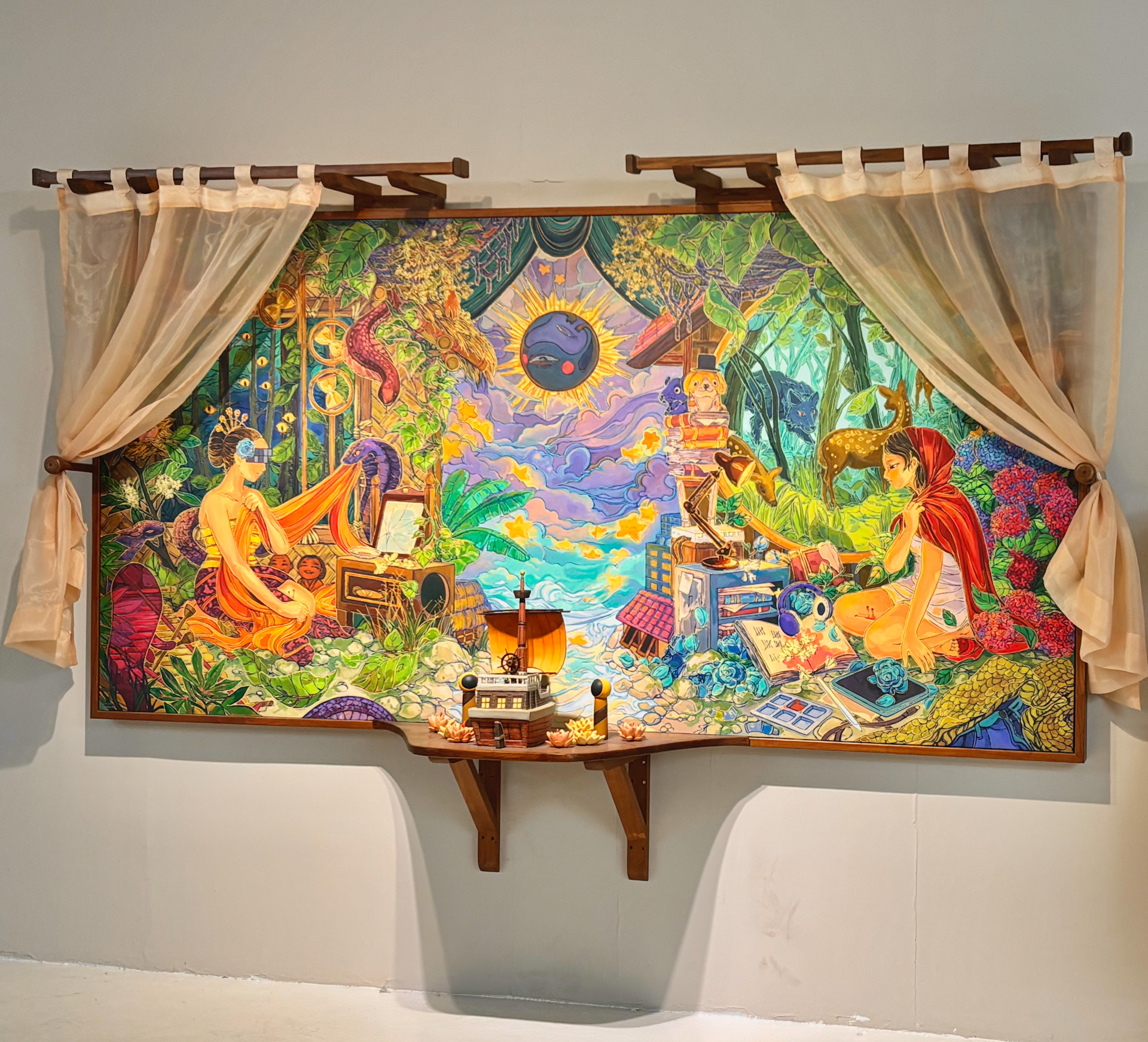
Conversation with Srintil
- Media : Acrylic on canvas, wood, resin, fabric
- Dimension : 210 x 330 x 64 cm
- Year : 2026
-
Description :
The concept of “Conversation with Srintil” was born from rumination after reading Ahmad Tohari’s Ronggeng Dukuh Paruk Trilogy, where Srintil is the main character. While the novels themselves were often discussed through political lens of the 1965 tragedy, I was personally more intrigued by how much of the tragedies in Srintil’s life still echoes the day to day reality of many women today.
This framework of objectification and opportunistic predation, captured through the Tohari’s portrayal of the people (particularly men) in Srintil’s life, persists from the old days to the 2020s. Empathy and professional decency are weaponized as openings for conquest. Platonic trust is twisted into an invitation for intimacy, where "no" is heard as "not yet." Intelligence and agency are dismissed as a "sickness of the shrew" to be tamed. Purity is worshipped yet defiled through “worship” itself—the consumption of a person’s sexuality regardless of agency. Despire the ‘modernity’ and progress in civilization, the predatory archetypes of Rasus, Marsusi, Bajus, and even the Kertareja couple never went away; they have simply evolved.The artwork itself consists of a painting and a modified frame. The visual narrative combines both Srintil and the Red Riding Hood, with the latter serving as a representation for ‘modern’, westernized, contemporary parallel.