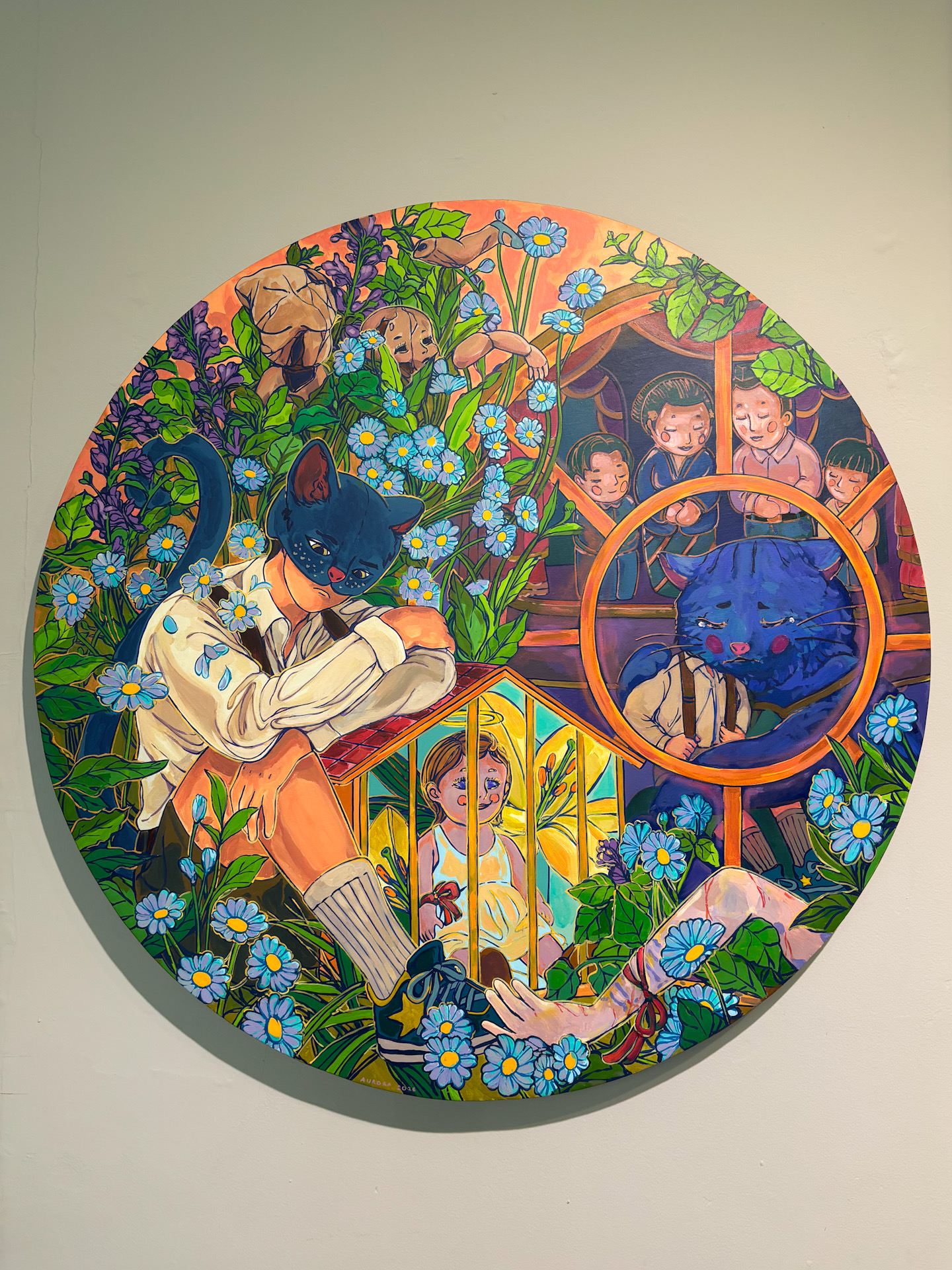
The Cat Man (Rasus)
- Media : Acrylic on canvas
- Dimension : Diameter 100 cm
- Year : 2026
-
Description :
The Cat Man is the manifestation of an unresolved Oedipal complex crossbred with a total absence of empathy and an inflated ego, resulting in a pattern of needing to objectify and dehumanize the women he ‘loves.’ It’s rather contradictory, indeed. Before discussing the pathology, it’s worth looking at the origins of this particular species.
The Cat Man was born and raised in an ‘empty’ and ‘unsafe’ environment. He grew up without a sense of emotional security. Frequently, it was he—as a child from an early age—who had to take responsibility for organizing life and safeguarding the inner fragility of his parents/guardians, sometimes including making critical decisions (moral and/or financial). This ingrained a specific mindset within the child: safety and affection come hand-in-hand with tight control and expectations that can only be imagined because they were never actually experienced.
The child look at their surroundings and begins yearning the ideal mother or father.That longing then fuses with lust within a maturing body, subsequently transforming into fantasies projected onto anyone he is sexually attracted to. In the case of the Cat Man, who is a heterosexual male, that role falls upon the woman he desires.
Now this is an understandable psychological response. However unfortunately for the Cat Man, he cannot separate his fantasies from the reality of the living being before him. And because no human can rival the perfection of a fantasy, sooner or later The Cat Man feels betrayed by the woman.
Regardless of whether that imperfection stems from human limits, or the stain of “sin” within the woman due to things beyond her control (i.e having been sexually abused before), or simply because the woman was so stunning that he became sexually aroused. In The Cat Man’s eyes, the woman is always the one to blame.
Exactly the way Rasus viewed Srintil, the Cat Man craves the purity of a virgin and the wildness of a whore, and he resents how the woman he likes makes him “dirty” with lust (the Madonna-Whore complex).
To him, the ideal woman does not think too much and does not invite desire—even if that desire stems from himself as the “owning” male.
Armed with this, the Cat Man then demands compensation for the disappointment born of his own delusions regarding the purity and peak perfection of womanhood, though of course he isn't the problem. No, all of this happens because the woman failed to conform to expectations.
So the Cat Man punishes his partner for violating his own fantasies, over and over again.
He will not let the woman go, because what if she makes the wrong decision like his mother, or leaves him the way his father once did? No, he insists on maintaining the relationship, promising to marry the woman to build the ideal home he never had in his entire life.
Yet he spends day after day polishing his fantasy, reducing the woman to nothing more than a lifeless doll that he can take apart and dress up as he pleases. And he throws tantrums like a toddler whose toy has been snatched away whenever the woman shows resistance or an intellectual agency that exceeds his desires.
But of course, no doll lasts forever. What if the doll eventually breaks from being twisted too much, or hugged too tightly in his sleep?
No problem!
Just as Rasus worships his fantasy of the ideal woman while satisfying his lust by sleeping with Srintil over and over again, only to abandon her on the grounds that Srintil is no longer “whole” to him, life goes on as usual for The Cat Man.
He can always make a new doll.
Again, and again.
And much like Rasus, who would reminisce and visit Dukuh Paruk without a shred of guilt or self-reflection, The Cat Man occasionally looks back at his doll’s grave in sweet nostalgia.
Not to take responsibility, but to enjoy a touristic recreation.