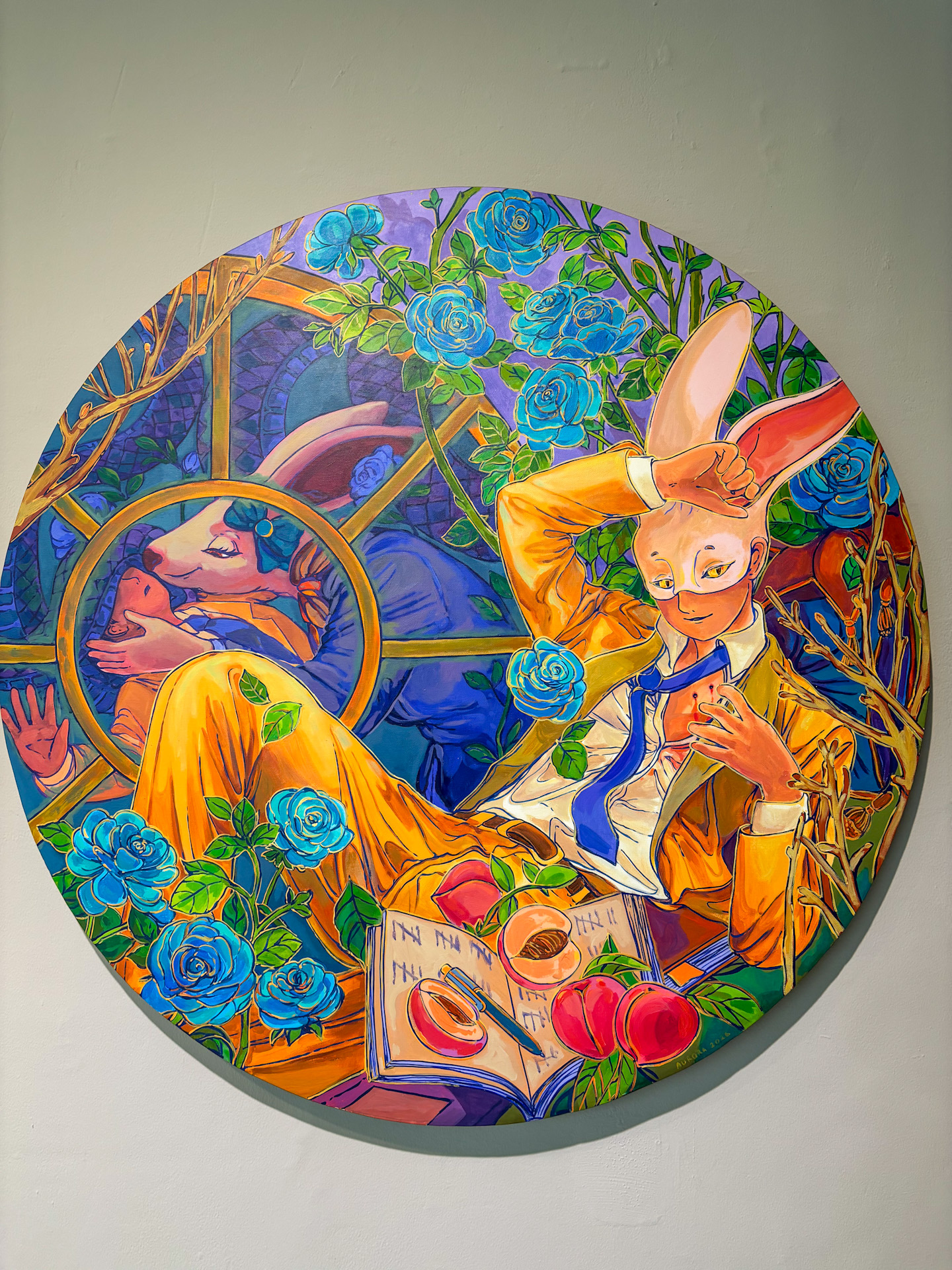
The Rabbit Man (Bajus)
- Media : Acrylic on canvas
- Dimension : Diameter 100 cm
- Year : 2026
-
Description :
Polite, sharply intelligent, and thoroughly Machiavellian, The Rabbit Man is a creature of a caliber far surpassing The Cat Man (Rasus) and The Bull Man (Marsusi). The Rabbit Man doesn't blame the woman for arousing his own desires, let alone punish her for "sins" committed against her by others. Nor does he resort to crudeness, much less act recklessly or panic to get what he wants. Instead, he presents himself as an understanding and empathetic, wounded fellow survivor.
Much like Bajus, who studied what Srintil needed in her despair after being released from detention camp post 1965 arrest, The Rabbit Man patiently and meticulously maps out his target before sweet-talking her with the exact things that female survivors of The Cat Man and The Bull Man desperately need in life-or-death despair: empathetic understanding and sense of safety born out of mirrored trauma.
And for female survivors in the 2020s teetering on the brink of suicide, this is more intoxicating than any mere offer of a financial transaction or the promise of a "respectable household."
But how does he know all this, and how can he fake it so convincingly? Bajus in Ronggeng Paruk came armed with financial capital and social status because those were precisely what a Srintil needed in that era. But what about The Rabbit Man? The things he offers cannot be fabricated based on cold, clear-cut data simulations. Convincing, profound empathy must be rooted in a personal reality that cannot be faked. So what is actually going on here?
This is where the evolution of the Bajus archetype enters an even more vicious realm than Rasus or Marsusi. While Bajus uses financial capital and tangible things as a currency of exchange, The Rabbit Man uses weaponized vulnerability.
He doesn't need to pretend to understand the experiences of female survivors because he has been in that position himself.
He knows their suffering because he has lived through the exact same thing firsthand.
He knows how to spot them in a crowd because he only needs to look for someone carrying the scent of a bleeding wound similar to his own.
He doesn't need to guess what a female survivor needs, because he longs for those exact same things for himself.
And he knows how to hurt a survivor without a single other soul knowing, because that same thing was once done to him.
The relationship between The Rabbit Man and the woman he sets his sights on—who is almost always a survivor of violence of one kind or another—is built on mirroring and trauma bonding. Each looks to the other for a savior. But shouldn't fellow survivors pull together to help each other heal? Sometimes they do, but not with The Rabbit Man. Salvation for him comes from recreating the cycle over and over again, but with himself sitting at the top of the food chain.
He wants to convince himself that he is now the predator, not the prey. It doesn't matter that all of this happens in the private sphere where the public can never see. The Rabbit Man needs to be reassured of his own status by himself, not by anyone else.
And how, exactly, does he operate, and how was he shaped?
The Rabbit Man carries wounds from violence he suffered at the hands of someone else—in this instance, a female figure more powerful than himself. In a society that emphasizes hierarchical masculinity over women as the ultimate determinant of a man's self-worth, this is a profound disgrace. The Rabbit Man cannot speak of his wounds without being haunted by the demand to present himself as the dominant party, or as a machine that feels no pain whatsoever, despite what his private reality tells him. He has to deny his own wounds; otherwise, he will become the laughingstock and punching bag of his environment. This instills two things within him: he must bottle up his pain without ever having the chance to understand its origins, and he must prove to himself—not to society—that despite what happened to him, he is no loser.
This need for validation has fused into an inescapable metric of his own self-worth. And because he cannot exact revenge on the very figure who became the source of his pain, he turns to other women who represent two things at once: a resemblance to the original perpetrator—in terms of gender, physicality, and relative social status hierarchy compared to him—and a reflection of the version of himself he hates for being weak and vulnerable—such as a survivor already battered by another predator.
He uses empathy as a trap, deploying strategic calculations to psychologically and socially manipulate circumstances to ensure his target is in no position to refuse any demand he makes without fatal consequences.
Just as Bajus trapped Srintil with a dependency on safety before forcing her to sleep with his superior just so he could gain favors at work, The Rabbit Man traps female survivors with the existential validation of a custom-crafted emotional intimacy—yes, The Rabbit Man studies his targets meticulously—acting as a narcotic that dulls the stinging pain of previous trauma and suppresses suicidal urges, all before demanding the destruction of her social relationships and the absolute surrender of her mind and body's agency to satisfy his own lust and cure his deep-seated inferiority. His "kindness" is nothing more than investment capital, and he demands maximum returns without a single care for the woman's well-being.
And just as Bajus ensured that Srintil could never seek help because of her status as a political prisoner and his status as a respected architect from Jakarta, The Rabbit Man makes sure that no one out there will easily believe or extend a helping hand to the woman, because he has carefully constructed a facade as a universally beloved man while placing a social distance between himself and her in public even before he ever ensnares her.
And what if that woman wants to be freed? The Rabbit Man doesn't care all that much, so long as he can keep his fangs sunk into her life. He will swiftly move on to a new prey, because rabbits are, after all, innocent yet intensely hypersexual creatures. But he doesn't simply let go of his old prey either. He would hover, and sometimes even send proxies, ensuring he remains 'unforgettable'.